

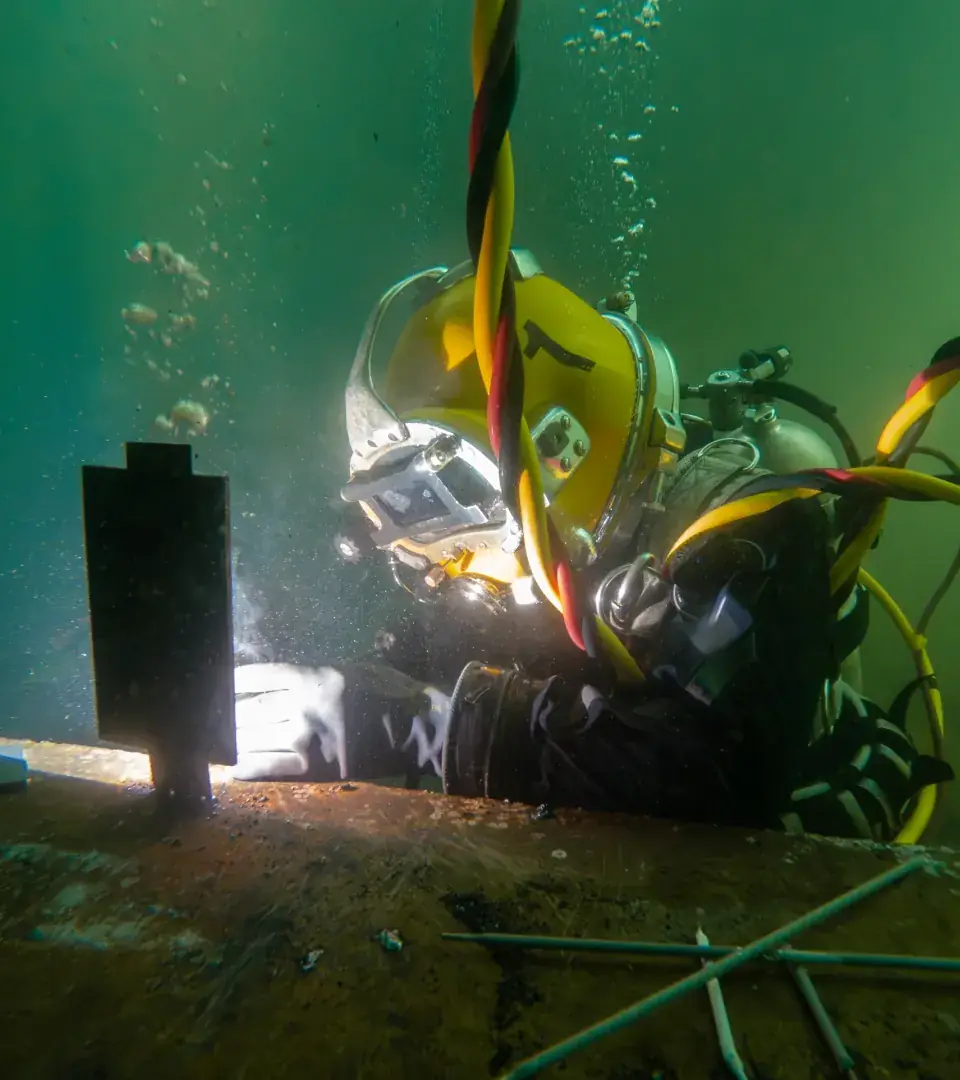
An improved underwater welding handle
Cheaper, tougher and easier to use, and now the standard design in Hong Kong's commercial diving industry.
Underwater welding and cutting are hard, exacting work. Drawing on years of work below the waterline, we redesigned the welding handle with three goals: lower cost, simpler use, and no loss of safety or performance.
A two-material torch head
Traditional heads are made entirely of phenol formaldehyde resin (Bakelite), which insulates well but is brittle. We kept Bakelite for the torch head and replaced the handle with a tougher, impact-resistant material. The redesigned head works like a screw cap, so divers can change the welding rod (E6010) underwater quickly.
A PVC grip for control
The handle is PVC (polyvinyl chloride). PVC resists water, keeps its properties when submerged, withstands impact and is a good electrical insulator. Pairing a PVC handle with a Bakelite head gives a torch that is durable, safe and dependable.
Design details that matter
The head and the grip both have grooves for friction, so the handle stays secure in a gloved hand. The rear of the handle has a trapezoid profile, which lets electrical tape wrap tightly around the handle, cable and copper core for a clean, insulated joint.
The modified handle is now the preferred choice for underwater welding in Hong Kong's commercial diving industry, and divers across the region follow our design and operating guidelines.